What it is
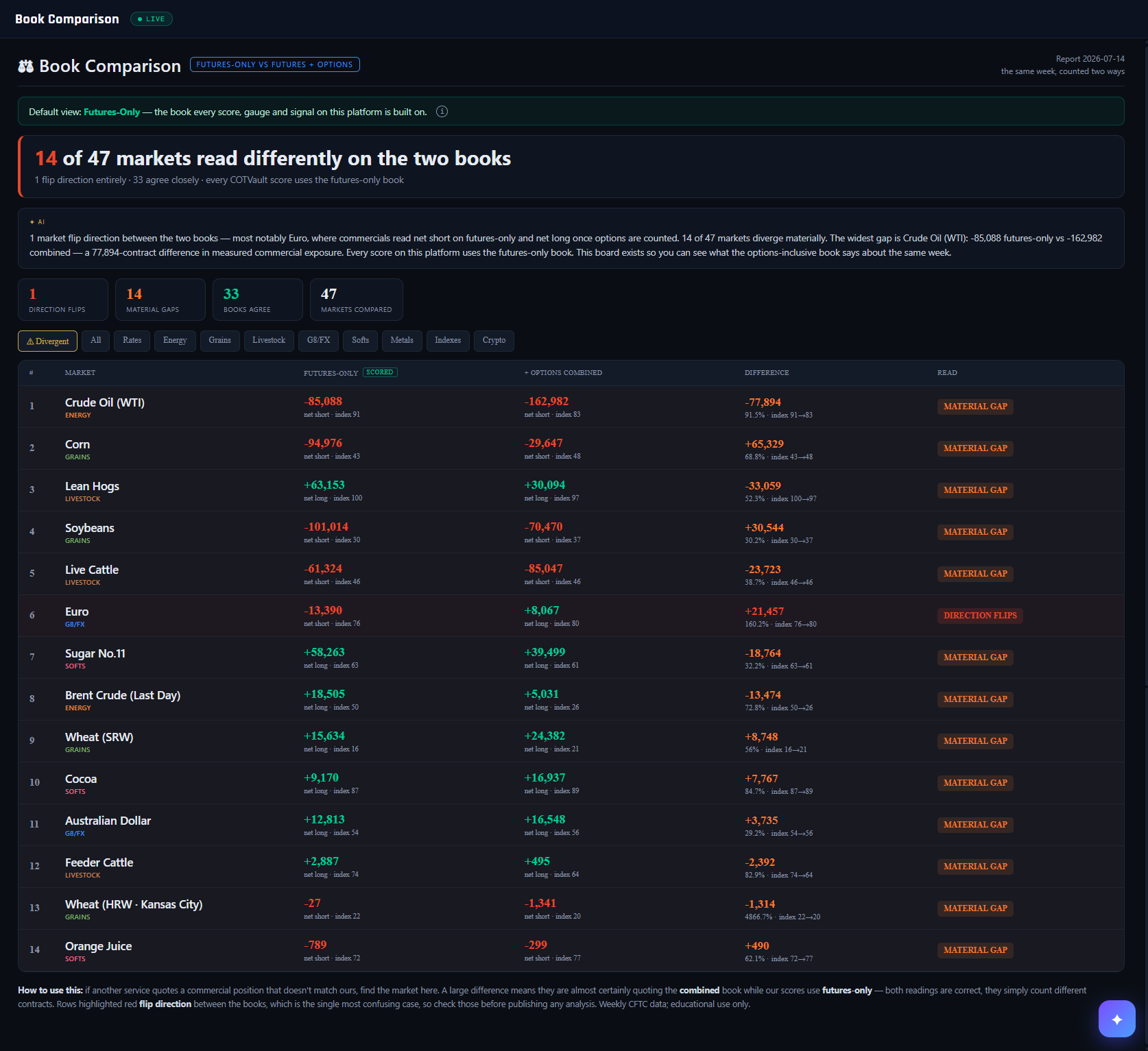
The CFTC publishes every COT report in two books: futures contracts alone, and futures plus options converted to their futures-equivalent size. Every score on this platform is built on the futures-only book — the classic standard. This board shows you what the other book says about the same week, side by side.
What it measures
For all 47 markets: the commercial net position and index on each book, the difference between them, and a verdict. 14 of 47 diverge materially this week. The widest is Crude Oil — −85,088 futures-only against −162,982 combined, a 77,894-contract difference in measured commercial exposure. Options-heavy markets like energy, grains and livestock diverge most.
Why it's useful to you
If another service quotes a commercial position that doesn't match ours, this is where you find out why — in seconds, with the arithmetic done. Both readings are correct; they simply count different contracts. Note what the index columns show, though: even where raw positions differ by 90%, the 0–100 index barely moves. That is why the platform's signals hold regardless of which book you prefer.
The 10-second read
Find the market in question. A large Difference means another service is almost certainly quoting the combined book. Red DIRECTION FLIPS rows are the ones that genuinely confuse people — check those before publishing anything.
Use it with: COT Intelligence · Setup Scanner · Academy lesson F2
1
Panel identity. “Futures-only vs futures + options” — the same CFTC week, counted two ways.
2
Default view banner. States plainly which book the platform scores on, so there is never any doubt about where your numbers come from.
3
The ⓘ explainer. Hover for what each book counts, why hedgers in some markets use options heavily, and why neither book is right or wrong.
4
Verdict banner. How many markets read differently, how many flip direction outright, and how many agree closely.
5
AI read. Names the direction flip and the widest gap in sentences, with the actual contract numbers behind both.
6
Summary chips. Direction flips, material gaps, books agree, markets compared.
7
Filter tabs. ⚠ Divergent shows only the markets that disagree; All shows every market; the rest filter by class.
8
Futures-only column. Marked SCORED — this is the book behind every gauge on the platform. Shows net position, side, and the 0–100 index.
9
Combined column. The same week with options included. Compare the two index values, not just the raw nets — that comparison is the real story.
10
Difference column. The gap in contracts, as a percentage, and how the index shifts. Crude's index moves only 91→83 despite a 91.5% gap in raw position.
11
Read column. The verdict: MATERIAL GAP, DIRECTION FLIPS, or books agree.
12
The widest gap. Crude Oil — nearly 78,000 contracts of commercial exposure that the futures-only book does not see, because oil hedgers lean heavily on options.
13
Direction flip. The Euro reads net short on futures-only and net long once options are counted. The one case that looks like a contradiction rather than a nuance — worth checking before you publish any euro analysis.
14
How to use this. The footer states the rule: a large difference means the other service is quoting the combined book; both are correct; check flip rows first.