14Extremes & Percentile — Is the Stretch Real?
VaultSingle-market view
Nav → Intermediate → Extremes & Percentile
№ MAP PINS — the gold markers on this screenshot point at locations on the panel; each is explained in the legend beside it. (They are separate from the teal STEP numbers in Part 1.)
1
2
3
4
5
6
7
8
9
10
11
12
What it is
The Beginner COT Index gives you one number on one window. This panel interrogates it: is that "extreme" real, or a short-window artifact? It runs the specialist's positioning through four normalization windows at once, adds a z-score as a second lens, and counts agreement and duration — a full cross-examination before you're allowed to call anything stretched.
What it measures
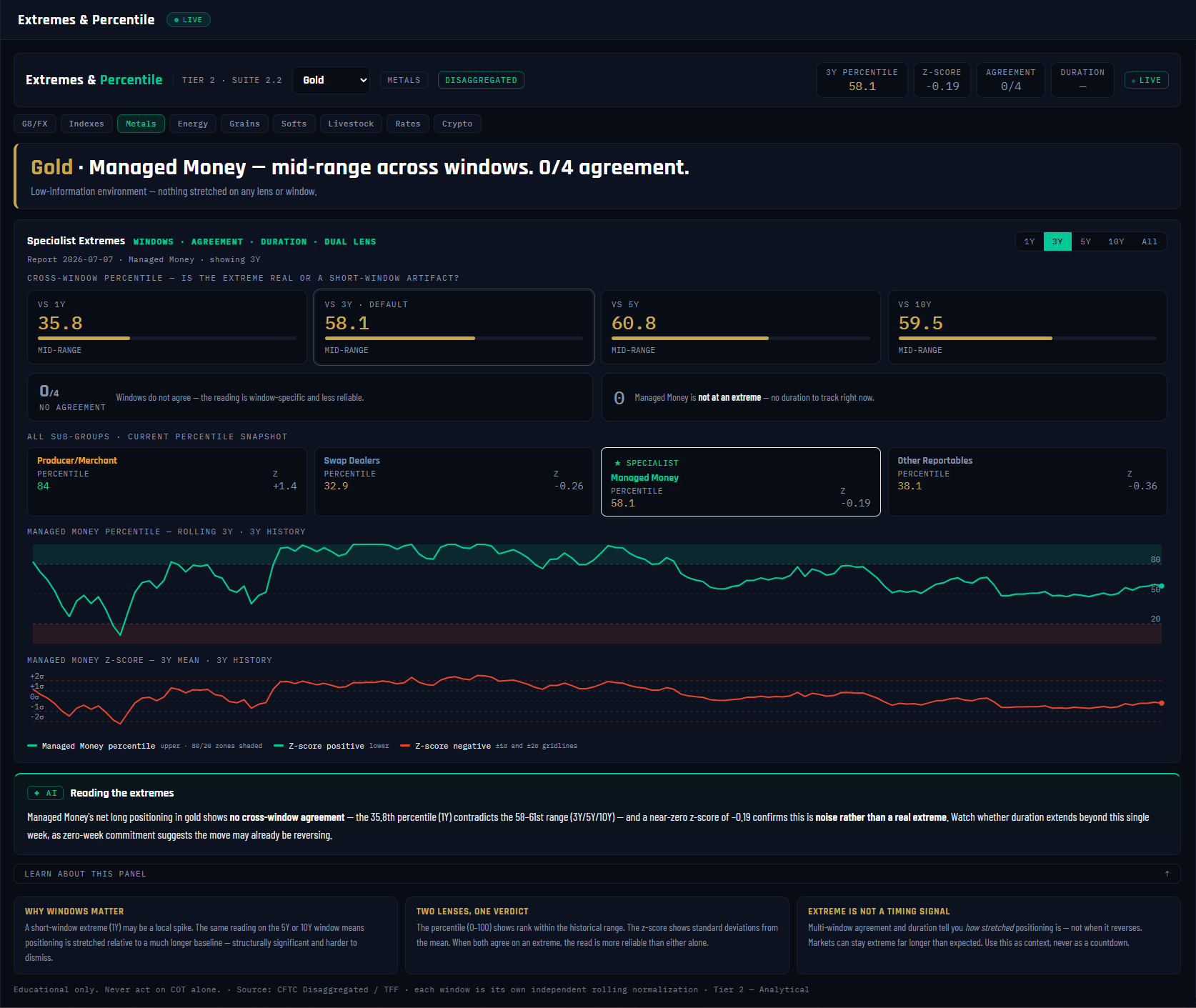
The specialist's net position (Managed Money in Gold) as a percentile across four windows — 1Y / 3Y / 5Y / 10Y — where the 3Y default matches the stored index exactly. Gold, week 2026-07-07: 1Y 35.8 · 3Y 58.1 · 5Y 60.8 · 10Y 59.5 — mid-range on every lens. Beside it, the z-score (-0.19 standard deviations from the 3-year mean) reads the same data on a different scale. AGREEMENT 0/4 counts how many windows confirm a stretched reading (past roughly 70/30, heading for the true 80/20 extreme zone); DURATION counts consecutive weeks the extreme has held. Gold scores zero on both — nothing is stretched.
Why it's useful to you
This panel exists to kill false alarms. A 1-year window can scream "extreme!" about a positioning level the 5-year window has seen a dozen times — trade the short-window spike and you're fading nothing. Multi-window agreement plus a confirming z-score plus multi-week duration is the difference between a structural extreme and noise. Gold is the clean negative example: 0/4 agreement, z-score near zero, no duration — a low-information week, and knowing that saves you from inventing a story.
The 10-second read
Agreement count first: 3/4 or 4/4 = a real extreme, 0–1 = ignore. Then duration — a stretch that has held for weeks is loaded; a fresh spike is just a spike.
Use it with: The Specialists (whose percentile this is) ·
The COT Index (the beginner version of the same math) ·
Pressure & Squeeze (what a confirmed extreme can coil into)
1
Stat chips. 3Y PERCENTILE 58.1 · Z-SCORE -0.19 · AGREEMENT 0/4 · DURATION —. Four chips, four tests; Gold fails all four to qualify as an extreme.
2
Verdict banner. "Mid-range across windows. 0/4 agreement." When nothing is stretched the panel says so plainly instead of manufacturing a lean.
3
Window tabs. 1Y / 3Y / 5Y / 10Y / All — the lookback for the history charts below. The window matrix above always shows all four regardless.
4
VS 1Y card — 35.8. Against just the last year, Managed Money sits in the lower-middle of its range — the one lens leaning the other way, which is itself informative.
5
VS 3Y · DEFAULT card — 58.1. The highlighted default lens, identical to the specialist index used across the platform. Mid-range.
6
VS 5Y and VS 10Y cards — 60.8 / 59.5. The long-baseline lenses. A reading that's stretched here is structurally significant; Gold's isn't stretched anywhere.
7
Agreement banner — 0/4 NO AGREEMENT. Counts the windows confirming a stretched read. "Window-specific, less reliable" is the panel's warning when lenses disagree; 3/4+ is when an extreme deserves the name.
8
Duration banner. Consecutive weeks the extreme has held. Gold: not at an extreme, so nothing to count. Duration is how loaded, never when it reverses.
9
All sub-groups snapshot. Every Disaggregated group's current percentile side by side, the ★ SPECIALIST highlighted at 58.1 — check whether any other group is at an edge the specialist isn't.
10
Percentile history. The specialist's rolling 3-year percentile with the 80/20 extreme zones shaded — every past trip to the edges and how long each one lasted.
11
Z-score history. Standard deviations from the 3-year mean, ±1σ and ±2σ gridlines. When percentile and z-score agree on an extreme, the read is more reliable than either alone — two lenses, one verdict.
12
✦ AI — "Reading the extremes." Cached per CFTC release. For Gold this week it flags the readings as noise rather than a real extreme — the honest call when 0/4 windows agree.