What it is
The Intermediate capstone — it takes everything the previous panels measure separately (the COT Index, velocity and acceleration, concentration) and fuses them into one question: where is the specialist crowd in the arc of its trend? Because the same bullish reading means opposite things depending on when it appears: index 60 while flow accelerates off a low base is a young trend worth following; index 60 while flow dies and the position crowds into fewer hands is a trend running out of road.
What it measures
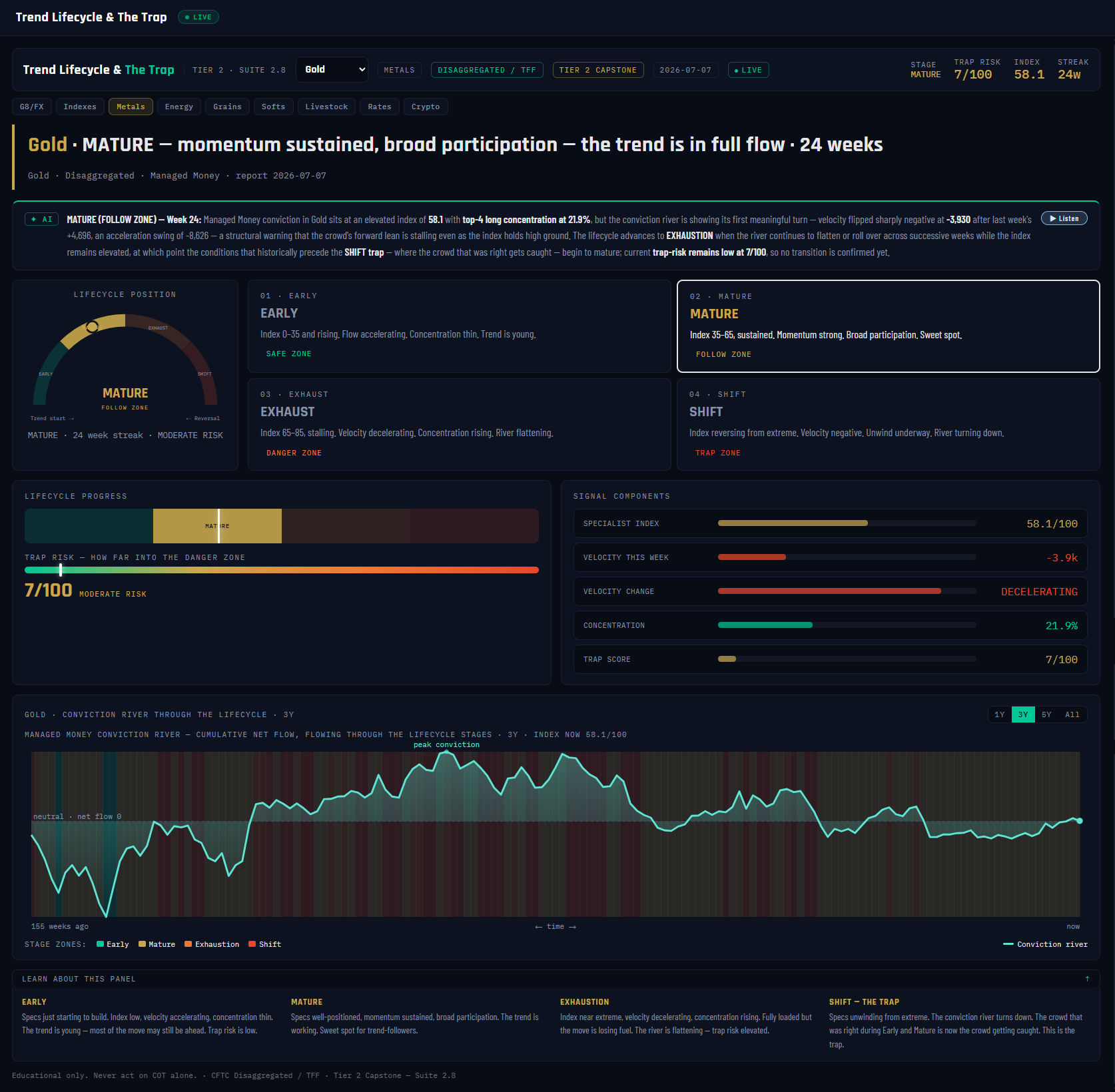
Four stages, classified every week from the index, velocity and acceleration. EARLY (safe zone) — index low and rising, flow accelerating, the trend is young. MATURE (follow zone) — index mid-range and sustained, momentum strong, broad participation: the sweet spot. EXHAUSTION (danger zone) — index high but stalling, velocity decelerating, concentration rising. SHIFT (trap zone) — the index reverses from its extreme, velocity turns negative, the unwind is underway. On top sits the trap-risk score (0–100): how high the index sits, how hard flow is decelerating, and how concentrated the position is — scaled down in early stages so a young trend can't false-alarm. Gold reads MATURE, 24 weeks in stage, trap risk just 7/100: index 58.1, velocity −3.9k and decelerating, but nowhere near the danger zone.
Why it's useful to you
This is the panel that names the Trap — the cruelest structure in positioning: the crowd that has been right for the entire trend is, at the end of it, maximally exposed with a tiny exit. Late-cycle crowded winners don't get to leave gracefully. The lifecycle read tells you which playbook applies right now: join (Early), follow (Mature), tighten up (Exhaustion), or stand aside from the crowd's side entirely (Shift). For Gold in the screenshot, the message is calm: a 24-week Mature trend, trap risk minimal — the crowd is committed, not cornered.
The 10-second read
Stage + trap thermometer. EARLY/MATURE with low trap risk = the trend has fuel. EXHAUSTION = fully loaded, losing fuel. SHIFT = the trap has closed — the unwind is live.
Use it with: Extremes & Percentile (the index leg of the stage call) ·
Velocity & Flow (the momentum leg) ·
Unwind Tracker (when SHIFT hits, this tracks the release week by week)
1
Panel title + market dropdown. Trend Lifecycle & The Trap · Tier 2 · Suite 2.8 — the Tier 2 Capstone, reading Gold's Managed Money crowd.
2
Stat chips. STAGE MATURE · TRAP RISK 7/100 · INDEX 58.1 · STREAK 24w. The composite verdict and its three main inputs.
3
Verdict banner. "MATURE — momentum sustained… 24 weeks." Stage, one-line meaning, and how long the market has held it.
4
AI lifecycle read + Listen. The week-24 narrative: the stage, its key drivers, and what triggers the next transition — for a Mature trend, watch the river flattening while the index stays high.
5
Lifecycle position gauge. Where Gold sits on the Early → Mature → Exhaustion → Shift arc: squarely in the follow zone.
6
Stage card 01 — EARLY (safe zone). Index low and rising, flow accelerating, concentration thin. Maximum runway; low trap risk by construction.
7
Stage card 02 — MATURE (follow zone), active. Highlighted because it's Gold's current stage: index mid-range and sustained, broad participation, momentum intact.
8
Stage card 03 — EXHAUSTION (danger zone). Index high but stalling, velocity decelerating, concentration rising — the warning stage where trap risk climbs fastest.
9
Stage card 04 — SHIFT (trap zone). The index reverses off its extreme with negative velocity: the unwind is underway and the crowded winner is caught. This is the Trap itself.
10
Progress bar + trap-risk thermometer. Gold's trap risk: 7/100. The score blends index height (40%), deceleration (35%) and concentration (25%), then scales by stage — Early trends are dampened, Shift counts in full.
11
Signal components. The live inputs behind the stage call: index 58.1, this-week velocity −3.9k (DECELERATING), top-4 concentration 21.9%, and the trap score. If you disagree with the verdict, argue with these.
12
Conviction river. Cumulative weekly flow over 3 years, drawn through stage-tinted background bands. The river's shape IS the lifecycle: rising = building, flattening = exhausting, turning down = the Shift. Twenty-four weeks of Mature is visible as one long, steady climb.